From “why” and “what” to “how” – a Sinevis playbook for CISOs.
TL;DR
In the previous articles of this PQC Series, we have aligned on why PQC matters (Parts 1–3), learned to see your cryptography with a CBOM (Part 4), and framed a migration plan (Part 5). Now, we need the tooling and operating model to execute without breaking the business.
Sinevis recommends a hybrid-first approach, a CycloneDX-aligned CBOM, targeted edge/signing pilots and early PKI automation, governed by board-level KPIs. This article shows how exactly we run it in the field.
Sinevis point of view (what actually works)
Start where impact is high and blast-radius is low: the edge (TLS/mTLS) and signing (code/firmware).
Go hybrid-first (classical + PQC) to preserve interop and guarantee rollback.
Automate early: PKI/certificate lifecycle is the bottleneck if left manual.
Treat PQC as an operating-model change, not an algorithm swap.
Measure and show evidence: CBOM coverage, hybrid capability, signing readiness, automation %, vendor milestones, and user impact (handshake delta).
Quantum Readiness: More Than a Technical Project
Transitioning to PQC is not just about swapping algorithms.
It’s a strategic, organization-wide initiative that touches every layer — from governance and compliance to applications and embedded systems.
A robust Post-Quantum Cyber Readiness strategy includes:
Crypto Discovery – Identify where cryptography is used across all systems, applications, and embedded devices.
Crypto Inventory & Classification – Build a Cryptographic Bill of Materials (CBOM) with key lengths, algorithm types, and certificates in use.
Risk Assessment – Prioritize systems and data with long-term confidentiality requirements.
Migration Planning – Define transition paths toward NIST-approved PQC algorithms (FIPS 203/204/205) and plan phased integration.
Governance & Policy Updates – Embed cryptographic agility into enterprise policies, procurement, and vendor contracts to ensure adaptability to future algorithm updates.
A practical framework (6 stages) — with tools that map 1:1
Stage 1. Context & Standards – Set the North Star
Use: NIST PQC standards (ML-KEM, ML-DSA, SLH-DSA), SP 800-57/131A for transition language, TLS 1.3 profiles.
Deliverables: One-page executive brief; internal cryptography standard updated with hybrid-first guidance.
Keep the “what changes” message tight – we are modernising key exchange and signatures; symmetric crypto at strong sizes remains viable.
Stage 2. Discover – Build your CBOM the right way
Model: CycloneDX (v1.6+) CBOM properties for algorithms, params, libraries, protocols, certificates/roots, keystores (HSM/KMS + JKS/PKCS12/PEM), signing flows, rotation policy, PQC/hybrid capability.
Quick discovery helpers:
TLS surface:
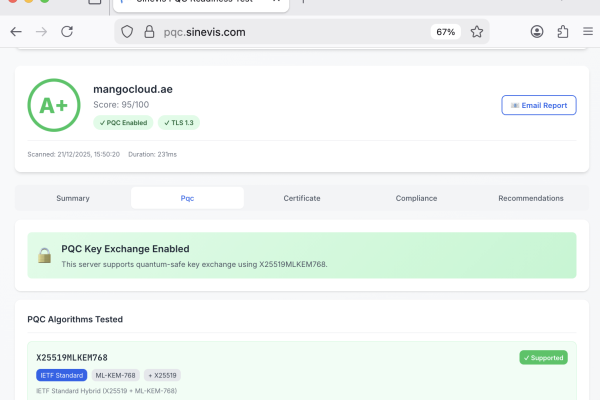
testssl.sh,sslyze, CDN/WAF exportsCertificates: PKI exports, Kubernetes cert-manager APIs, JVM
cacerts, Linux trust storesApp keystores: scripted find for
*.jks,*.p12,*.pemin images/containers/reposSigning: CI/CD pipelines, mobile/firmware release scripts, code-signing services
Output: CBOM for your top 20 services + tags: data longevity, business criticality, vendor dependence.
Stage 3. Assess – Prioritise with evidence
Scorecard (0–5 across 6 domains): Edge/TLS, Signing (code/firmware), PKI & cert automation, Data longevity & crypto policy, Vendor posture, Governance & metrics.
Config validation:
zlintfor X.509 linting; policy checks for ciphersuites and certificate profiles.Decision artifact: Impact × Effort heatmap to pick the first two pilots.
Sinevis tip: Your first 90-day wins live in the High-Impact / Low-Effort quadrant—usually an internet-facing API gateway and one code-signing path.
Stage 4. Pilot (Hybrid-First) – Make it real, safely
Crypto libraries (lab): Open Quantum Safe (liboqs), OpenSSL 3 oqs-provider.
Edge enablement: Envoy / NGINX / HAProxy in front of a single public channel; enable hybrid KEM; capture pcaps and app telemetry (handshake size, latency, CPU, TLS error rates).
Signing pilots: sigstore/cosign for software/container signing; trial dual-signing (classical + PQC) where supported; verify on CI, MDM, secure-boot, update agents.
Rollback guardrail: Keep classical-only configs pre-staged until stability is proven.
Exit criteria: Documented deltas, no SLO violations, interop confirmed, and a rehearsed rollback.
Stage 5. Automate — Industrialise PKI & certificate lifecycle
Core: cert-manager (Kubernetes) or equivalent for automated issuance/renewal; short-lived certs; versioned profiles for hybrid/PQC.
PKI orchestration: smallstep/step-ca, CFSSL, or commercial CAs; enforce rotation SLOs and auditability.
HSM/KMS policy: dual control, custody logs, restore exercises.
Trust governance: standardise roots/intermediates, app-local stores (JKS/PKCS12/PEM), JVM
cacerts, mobile SPKI pinning with backup pins.
Sinevis tip: Don’t attempt scale before lifecycle automation; manual PKI will stall you at 30–40% coverage.
Stage 6. Scale & Operate – Governance, partners, performance
Vendor diligence (ask for dates): Which ML-KEM / ML-DSA / SLH-DSA, where, and when? Hybrid support & ciphersuites? Measured handshake/latency/CPU? Certificate profile/tooling changes? Code/firmware signing path? Classical interop & rollback? Evidence pack (configs/pcaps/logs).
Policy updates: Crypto standard (with hybrid-first), CP/CPS, SDLC gates for signing & crypto-agility, third-party clauses with dated milestones.
Board metrics to track quarterly:
CBOM coverage (% Tier-1 services inventoried)
PQC capability (% edge traffic negotiating hybrid)
Signing readiness (% code/firmware flows PQC-tested)
Automation (% certs under automated lifecycle)
Vendor alignment (% strategic vendors with dated roadmaps)
User impact (median/p95 handshake delta on critical channels)
Deep dives for fintech (where issues show up first)
Mobile apps (handshake budgets)
Risk: Hybrid adds bytes/CPU; mobile radios add RTT/jitter; SDKs may use their own TLS stacks.
Targets: TTFB ≤200 ms (Wi-Fi), ≤300–400 ms (4G) on auth/checkout; handshake delta <50 ms median.
Do: A/B classical vs hybrid on real devices and network profiles; verify SPKI pinning with backup pins; staged rollout + kill switch.
Payments (open banking/PSD2, 3DS, issuer/acquirer/PSP, SWIFT & schemes)
Reality: Multi-party chains, strict SLAs, versions drift.
Do: Stand up a PQC-capable edge; certify mTLS profiles in partner sandboxes; pre-agree change windows; keep classical rollback.
KPIs: Auth success, p95 auth/settlement latency, SLA breaches by corridor, % traffic hybrid-capable.
Deployment Architecture
Edge pattern (internet-facing)
Client ↔ CDN/WAF ↔ Gateway (hybrid) ↔ App tier (classical permitted during pilot)
Pros: isolated blast-radius, measurable, visible to leadership.
Watch: cert profile sizes, device/SDK TLS differences, pinned endpoints.
Service-to-service mTLS (controlled zones)
Service A (hybrid) ↔ Mesh/gateway ↔ Service B (classical/hybrid)
Pros: you control both ends; great for early automation runs.
Watch: mesh proxies, sidecar versions, cert rotation cadence.
Dual-signing supply chain
Build → Sign (classical + PQC) → Verify (CI, MDM, secure boot) → Release
Pros: long-lived trust, auditability.
Watch: artifact size limits, bootloader acceptance, fleet rollouts.
Pilot runbook (90-day reference)
Days 0–15
Confirm the channel (one API), SLOs, and success metrics.
Enable packet capture and APM metrics; snapshot baselines (classical).
Stage hybrid config + rollback path.
Days 16–45
Turn on hybrid for ≤10% traffic.
Measure handshake size/latency/CPU; validate SDK/mobile behaviour; fix cert chain bloat.
Increase to 25–50% after stability; rehearse rollback.
Days 46–90
Run peak-hour tests; capture evidence (pcaps/logs/configs)
Present deltas and a scale decision to leadership.
Prepare PKI automation rollout if criteria met.
Common pitfalls (and how we avoid them)
Boiling the ocean: Start with two pilots. Prove, then scale.
Ignoring app-local keystores: Include JKS/PKCS12/PEM and JVM
cacertsin CBOM.Manual certificate work: Automate by Day 90.
No rollback plan: Keep classical path active until stability is documented.
Thin evidence: Collect pcaps + logs + APM; boards and auditors will ask.
What it costs (time/effort lens)
Low effort / high impact: CBOM for top 20; edge hybrid pilot; signing lab test; vendor questionnaires.
Moderate: PKI profile updates; cert-manager rollout; partner sandbox certification.
High: Full partner ecosystem upgrades; dual-signing firmware at scale; SWIFT corridor cutovers.
How Sinevis helps (engagement model)
Readiness sprint (4–6 weeks): CBOM build-out, scorecard, heatmap, and two pilot designs.
Pilot execution (6–12 weeks): Hybrid edge pilot + signing pilot with rollback rehearsals and evidence packs.
Scale & govern (quarterly): PKI automation, vendor roadmaps with dates, policy updates, and board KPI reporting.
Deliverables you keep: CBOM (CycloneDX), pilot configs & pcaps, readiness scorecard, board heatmap, PKI profiles, vendor RFI/Q pack, and a 90/180/365 roadmap your team can run.
Final Thought:
Post-quantum readiness is crypto modernisation with guardrails. If you start hybrid-first, automate lifecycle early, and manage this as an operating model, you’ll protect long-lived data, preserve customer experience, and show measurable progress—without boiling the ocean.
Our Post-Quantum Readiness Series
This article is Part 6 of our Post-Quantum Cyber Readiness Series, where we are covering complex concepts.
In this series, we covered:
- Part 1: Introduction to Post-Quantum Cryptography
- Part 2: Understanding Quantum Threats and “Harvest Now, Decrypt Later” Attacks
Part 3: NIST PQC Standards – What Organisations Need to Know
Each article will equip CEO’s, CISOs, IT leaders, and Architects with the knowledge and tools to navigate the quantum transition confidently.