The Quantum Shift Is Coming
For decades, we have relied on encryption algorithms such as RSA and ECC to secure our digital infrastructure – from online banking transactions to government communications. But the dawn of quantum computing is set to change that forever.
Quantum computers are now advancing rapidly through both public and private investments. They promise to perform certain calculations exponentially faster than classical computers. While this is revolutionary for science, medicine and AI, it is also a ticking time bomb for digital security.
This paradigm shift is what the cybersecurity world calls “Q-Day”, the day when quantum computers can break today’s encryption standards within days or even hours.
What Is Post-Quantum Cryptography (PQC)?
Post-Quantum Cryptography (PQC) refers to cryptographic algorithms designed to be secure against quantum computers, while remaining compatible with today’s digital infrastructure.
National Institute of Standards and Technology (NIST) has selected post-quantum algorithms for standardization.
NIST began publishing the final Federal Information Processing Standards (FIPS) for these algorithms, marking a new era in digital security.
The Four NIST-Approved PQC Standards:
ML-KEM (FIPS 203)
Module-Lattice-Based Key-Encapsulation Mechanism Standard
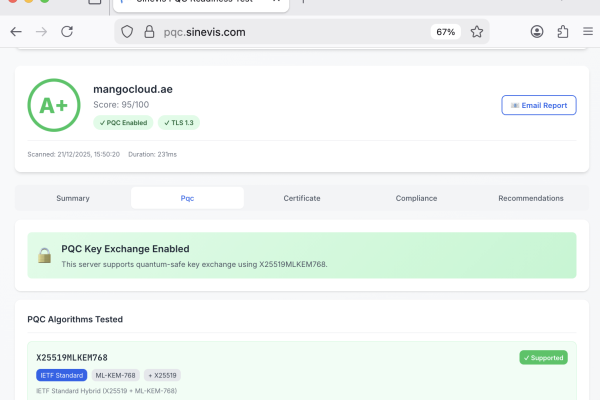
A lattice-based key-encapsulation mechanism (successor to RSA/ECC key exchange). It provides fast, efficient key establishment for TLS, VPNs and general encryption protocols.
ML-DSA (FIPS 204)
Module-Lattice-Based Digital Signature Standard
A lattice-based digital signature algorithm designed to replace RSA and ECDSA for authentication and code-signing.
SLH-DSA (FIPS 205)
Stateless Hash-Based Digital Signature Standard
A stateless hash-based signature scheme derived from SPHINCS+, offering extremely conservative security at the cost of larger key and signature sizes.
FN-DSA (FIPS 206, draft)
FFT (fast-Fourier transform) over NTRU-Lattice-Based Digital Signature Algorithm
A compact lattice-based signature algorithm (derived from Falcon), currently advancing through standardization and expected to be finalized soon.
The Business Impact: A Cryptographic Cliff Ahead
Organizations face what we often call a “cryptographic cliff.”
Your current encryption will not simply degrade, it will collapse once quantum decryption becomes feasible.
Think about:
Online Banking transactions that rely on TLS certificates using RSA or ECC.
Software updates signed with classical digital signatures.
Encrypted backups and data archives meant to remain secure for years.
Each of these is at risk of exposure once quantum computers reach sufficient scale. The question is not if, but when, and whether your organization is ready to migrate in time.
Quantum Readiness: More Than a Technical Project
Transitioning to PQC is not just about swapping algorithms.
It’s a strategic, organization-wide initiative that touches every layer — from governance and compliance to applications and embedded systems.
A robust Post-Quantum Cyber Readiness strategy includes:
Crypto Discovery – Identify where cryptography is used across all systems, applications, and embedded devices.
Crypto Inventory & Classification – Build a Cryptographic Bill of Materials (CBOM) with key lengths, algorithm types, and certificates in use.
Risk Assessment – Prioritize systems and data with long-term confidentiality requirements.
Migration Planning – Define transition paths toward NIST-approved PQC algorithms (FIPS 203/204/205) and plan phased integration.
Governance & Policy Updates – Embed cryptographic agility into enterprise policies, procurement, and vendor contracts to ensure adaptability to future algorithm updates.
Final Thought: Prepare, Don’t Panic
Quantum computing doesn’t spell the end of cybersecurity, but it does require proactive adaptation.
The organizations that start preparing now will not only safeguard their data, but also gain a competitive advantage by ensuring compliance and customer trust in the post-quantum era.
The future of cryptography is already being written.
The only question left is – will you be ready?
Our Post-Quantum Readiness Series
This article is Part 1 of our Post-Quantum Cyber Readiness Series, where we are covering complex concepts.
In this series, we covered:
- Part 1: Introduction to Post-Quantum Cryptography
Part 2: Understanding Quantum Threats and “Harvest Now, Decrypt Later” Attacks
Part 3: NIST PQC Standards – What Organisations Need to Know
Each article will equip CEO’s, CISOs, IT leaders, and Architects with the knowledge and tools to navigate the quantum transition confidently.